Autism and MMR:
Something is Rotten in Denmark
In 1987, the MMR vaccine was introduced in Denmark. By 1991, the number of cases of autism had begun to rise sharply in four year old children. In 2002 a report was published about a retrospective study of the largest number of children to date, incorporating over 500 thousand medical records.
The report is known in English as, A Population-Based Study of Measles, Mumps, and Rubella Vaccination and Autism by K.M. Madsen and Others and was published in The New England Journal of Medicine (NEJM) November 7, 2002 (Vol. 347 No. 19). The authors claimed to confirm that there was no connection between autism and MMR vaccine. Their manipulation of statistics is at best mistaken and at worst, deliberate fraud. Fortunately, the NEJM article published some raw data from the study. Table 1, below left, is an excerpt from the study data. Below and right, some clarifying comments have been superimposed on the same table. Note the middle column of each excerpt: 440,655 vaccinated children received six vaccines in the first year of life plus the seventh vaccine, the MMR, at a median age of 17 months. The right column, labeled “unvaccinated”, lists 96,648 children who actually received 6 vaccines in the first year of life but NOT the MMR at 17 months.
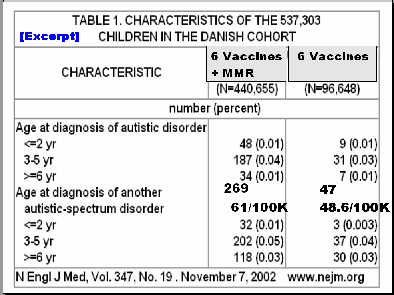
The 440,655 children who received 7 vaccines, experienced a total of 269 cases of autistic disorder. The 96,648 children who received 6 vaccines (no MMR), had a total of 47 cases of autistic disorder. Because the group sizes are different, the meaning of the figures is not obvious. However, the figures convert to: 61 cases of autistic disorder per 100,000 children in the group that received the MMR vaccine and 48.6 cases of autistic disorder per 100,000 children in the group that did NOT receive MMR vaccine. Clearly the MMR vaccine significantly contributed to a higher number of autistic cases, about 12 higher per 100,000, in the group that received the MMR vaccine.
All vaccines contribute to autism rates. Several news stories in 2005, by Senior Editor, Dan Olmsted of the United Press International, focused on the low, nearly zero, rates of autism among the mostly unvaccinated Amish.(1) In December of 2005 another unvaccinated population with no autism was found in 30 to 35 thousand children in the Chicago area.(2)
(Links in (1) and (2) updated 5/2014)(1) http://www.upi.com/Science_News/2005/04/19/The-Age-of-Autism-The-Amish-anomaly/UPI-95661113911795/ The Age of Autism: The Amish anomaly (part 1)
(2) http://www.upi.com/Health_News/2005/12/07/The-Age-of-Autism-A-pretty-big-secret/UPI-68291133982531/ The Age of Autism: 'A pretty big secret'
The NEJM reprint of A Population-Based Study of Measles, Mumps, and Rubella Vaccination and Autism by K.M. Madsen and Others may be found here: http://content.nejm.org/cgi/reprint/347/19/1477.pdf
This web page in a PDF for printing and distributing.
See http://www.vaclib.org/news/table1.htm for more information on the above NEJM article.
Evidence from Japan that MMR vaccine contributes to higher autism rates.
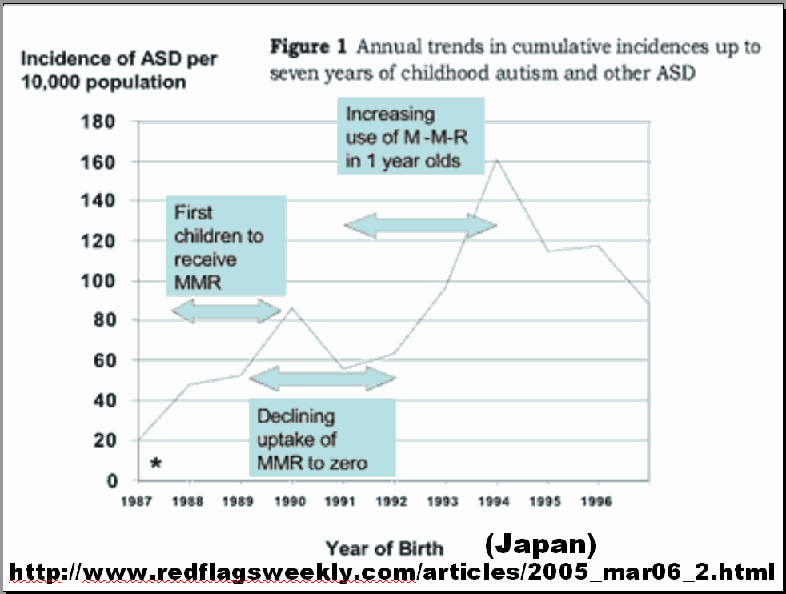
The graph above and quote following are from RedFlagsWeekly web site that is now archived here:
https://web.archive.org/web/20050307102935/http://www.redflagsweekly.com/articles/2005_mar06_2.htm
“Japanese study is the strongest evidence yet for a link between MMR and autism
Commentary By Andrew J Wakefield FRCS FRCPath and Carol M Stott PhD on the study: "No effect of MMR withdrawal on the incidence of autism: a total population study" by Honda H, Shimizu Y and Rutter M. published in the Journal of Child Psychology and Psychiatry, February 2005
Honda and colleagues present a fascinating report on the cumulative incidence (numbers of new cases with time) of autistic spectrum disorders
(ASDs) in the Kohoku Ward, Yokohama, Japan, for children born 1988 to 1996. The study seeks to examine the relationship between ASD and MMR
vaccination. Japan is unique since MMR was introduced in 1989 and discontinued in April 1993. Honda et. al. see this as providing an ideal
opportunity to test whether there is a causal association between MMR exposure and incidence of ASDs. They predict that, if MMR causes autism,
stopping MMR should result in a subsequent decline in incidence. This was not seen. In fact, there was a striking rise in the incidence of
ASDs in this population over time, with a marked rise postdating the removal of MMR. The authors state that their finding ‘implies that MMR
could not cause a substantial proportion of cases of autism’. “
Now for a little realism:
The graph above shows a 25 percent drop in autism between 1990 and 1991. Also note the MMR vaccine was not simply withdrawn but rather the MMR,
a triple antigen (measles, mumps and rubella) vaccine, was withdrawn from the market and in its place three separate jabs given close together
in time were introduced. So in fact, there was a marked decline in autistic cases among those who received neither the MMR or
the M and M and R in three separate injections. More information may be found
here: http://childhealthsafety.wordpress.com/2009/06/03/japvaxautism/
This web page in a PDF for printing and distributing.
More information on the increase of autism in Japan is directly related to the number of MMR and single measles vaccines.
archive of: http://homepage.ntlworld.com/clifford.g.miller/hondarutter.html
NEJM reprint of "A Population-Based Study of Measles, Mumps, and Rubella Vaccination and Autism" by K.M. Madsen and Others
Autism, MMR Article INDEX and Reversing Autism
The Un-Vaccinated are more Healthy - and have almost no autism